

Inventors of sponge for molecules receive Nobel Prize
The Nobel Prize in Chemistry goes to the inventors of a type of sponge for molecules. With their metal-organic materials, you can even extract water from the desert air. Richard Robson, Susumu Kitagawa and Omar Yaghi were the pioneers of metal-organic frameworks with cavities in which you can capture exactly one molecule.
Spheres with holes
In the 1970s, Australian Robson made wooden atomic models (spheres with sticks and holes) that could be used to recreate molecules. By puzzling with them, a molecular framework emerged. In the late 1980s, he demonstrated that atoms could be captured in the cavities.
Perhaps a surprising winner. Monique van der Veen (Chemical Engineering): “Richard Robson was completely unknown to many people in the field. His pioneering work had been forgotten by everyone. At the international MOF conference in New Zealand in 2018, Robson was honored and was able to talk about his groundbreaking discoveries in 1989 and 1990. He tried to trap salts and organic molecules with a specific geometry together in lattices with ‘space’ between them, which creates pores. Almost no one believed it would be possible to create a crystalline form. But Robson succeeded. He is a very modest man. I doubt that if it hadn’t been for that conference, things would have turned out the way they did at the Nobel Prize ceremony.”
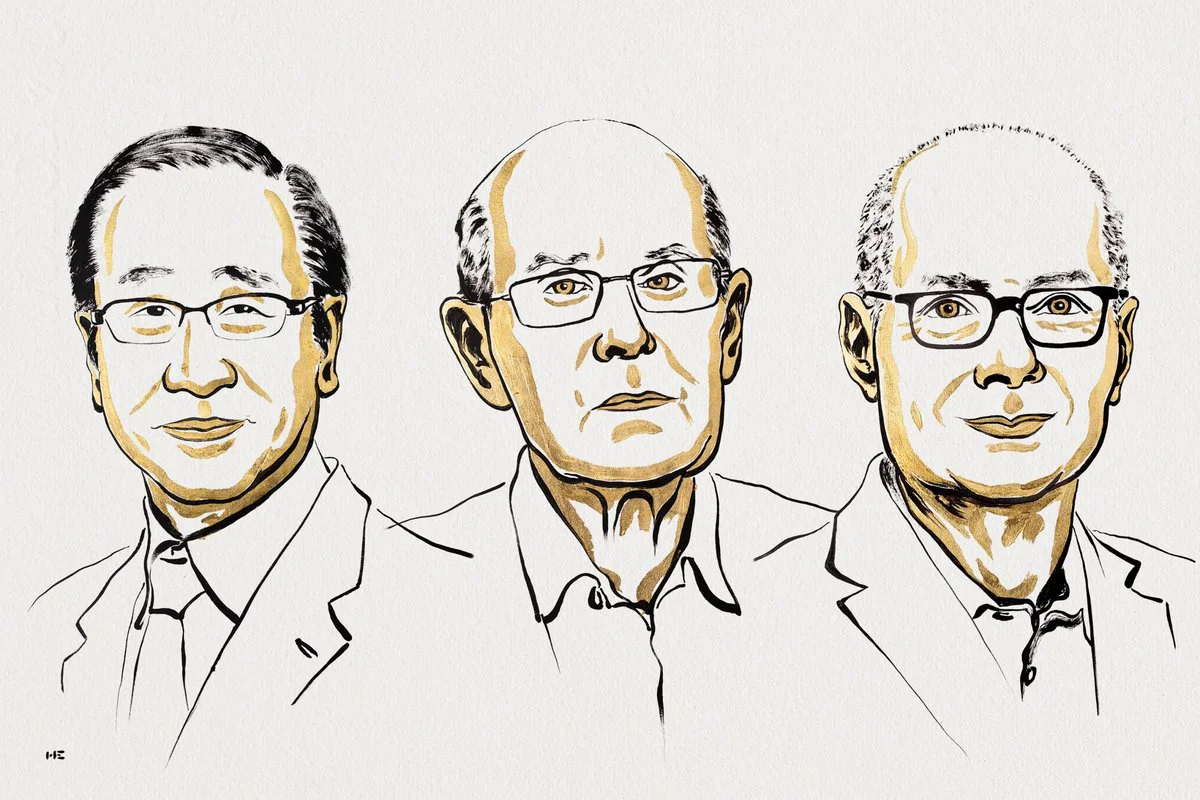
Van der Veen is more familiar with the work of the other two winners. “Kitagawa and Yaghi were the first to synthesize such structures in the late 1990s, whereby the structure remained intact even when the liquid was removed from the pores. This was not yet possible with Robson’s structures.”
“Kitagawa played around a lot with the flexibility of MOFs. Think of a wine rack that you can fold up. He realized very early on how that flexibility works and what possibilities it offers. I’m working on that myself now. The organic part of the molecule can often move. If those organic molecules are close together in the lattice and can touch each other, they influence each other. A bit like people moving together in a crowd. I’m investigating exactly how this works.”
Different metal-organic frameworks (MOFs) have different cavities and therefore different applications. For example, they can remove CO2 or certain toxic gases from the air, as Omar Yaghi has demonstrated. “It is possible, but difficult, to remove CO2 from the air with a MOF because water gets in the way,” explains Van der Veen. “I am trying to produce MOFs that are not affected by water.”
Another striking example is that Yaghi can extract water from dry desert air using MOFs. Van der Veen: “It works, but with limited production: you get five liters of yield per kilogram of material per day. I want to improve transport through the pores so that the water can flow through faster for a higher yield.”
According to the Nobel Prize Committee, we are on the verge of a breakthrough, and companies are investing heavily in the development of these molecular lattices.
House of cards
Fokko Mulder (Chemical Engineering) has worked extensively on MOFs in the past and is also enthusiastic about the award. “They are very porous materials that can be used to create structures like a house of cards. Very interesting. We worked on modifications to make certain MOFs more water-resistant, otherwise they fall apart in the open air. And we investigated whether they were suitable for storing hydrogen. That turned out to be possible, but not very user-friendly. We ended up going in a different direction. Nevertheless, they are fascinating materials that have sparked a lot of other research and are still being worked on extensively.”
In short, very deserving winners, agrees Monique van der Veen. She does add a caveat: “If Gérard Férey were still alive, he might have been included as well. In the 2000s, he made a huge leap forward in the stability of MOF materials and contributed greatly to the field. Thanks to him, the research has taken a huge step forward.”
HOP, Bas Belleman / Delta, Edda Heinsman


Comments are closed.