
TU Delft was once again at Lowlands Science last weekend for the first time in years. The researchers found plenty of guinea pigs there, even if they were a bit worse for wear. “Two days ago I would’ve given better answers than on this hung‑over afternoon.”
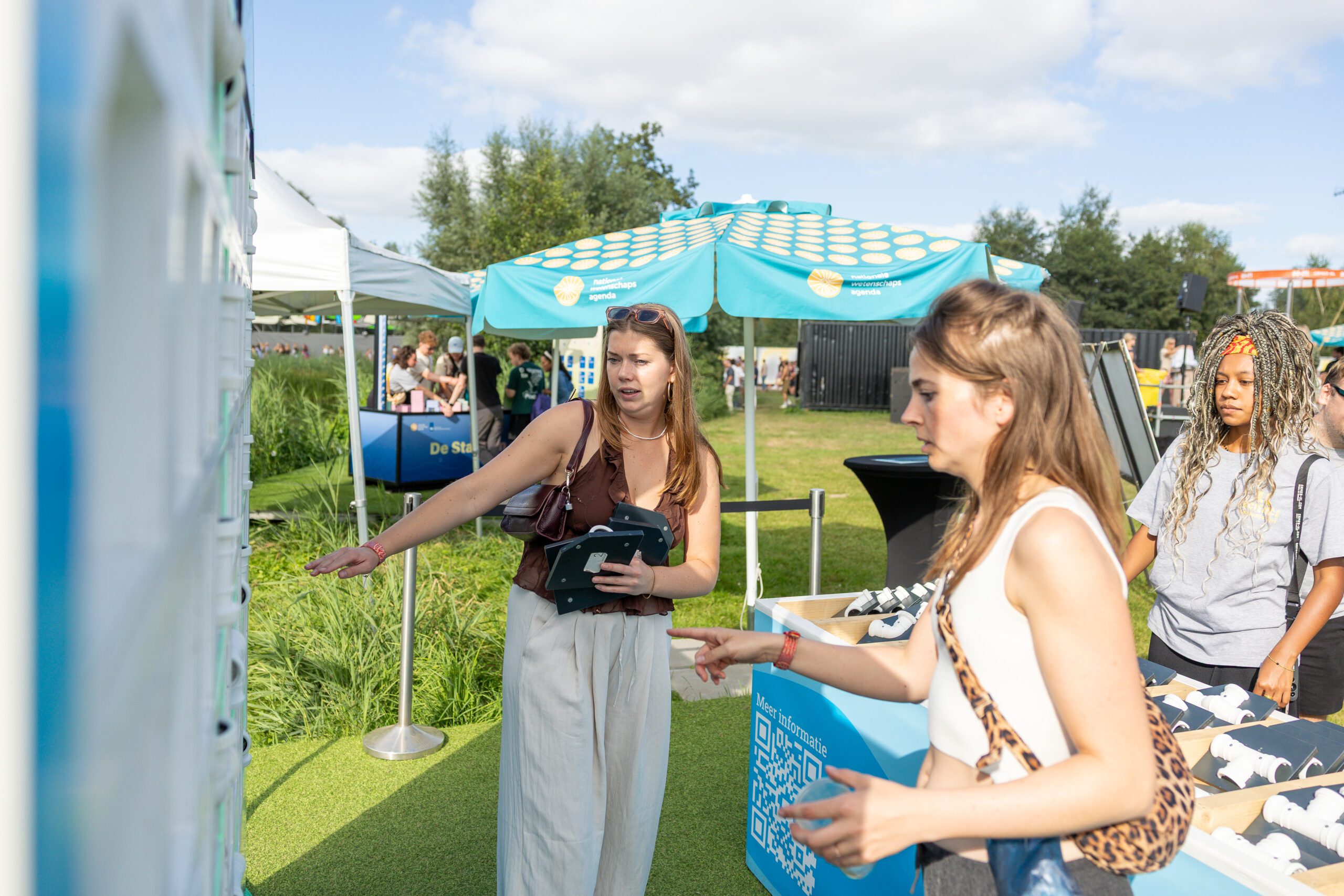
Participants contribute to the water pipe game of Sander Wingelaar. (Photo: Robèrt Kroonen)
Smiling broadly, TU Delft researcher Annelot Broerze stands at one of the containers at Lowlands Science that serve as mini labs this weekend. An inflatable globe wobbles above her head. With great enthusiasm she tells how enjoyable it is to be at Lowlands, even if you are working on a serious subject – Broerze’s research is connected to climate change. “On Friday a visitor said that I should not look so happy as it was not appropriate. But I will keep on smiling!”
Welcome to Lowlands Science, next to the Alpha – the main stage of the Dutch Lowlands festival. Here, serious science is done, as is the festival’s tradition. There is a science café, a daily National Science Quiz, and 14 researches that range from horror films to gender types, caffein and wastewater. The festival goers are the researchers’ guinea pigs. After having been absent for years, TU Delft was there again with three projects.
One of the TU Delft pieces is that of Gijs Tuinman (Faculty of Industrial Design Engineering) who is doing research into the importance of touch with the Dutch Touch Society research collective. We typically take touch for granted, he explains, “It is so natural that we hardly think about it.”
Touch
This changed during the Covid pandemic. “You saw that people really suffered from touch deprivation.” Physical contact is thus important. But does it matter who or what you touch? This is what he and his fellow researchers are hoping to find out at Lowlands.
The horror film posters on the walls of the container show what awaits the participants. Tuinman has created a mini-cinema at the back of the container: “It may be the smallest in the Netherlands”. There are four chairs and on the programme is a scene from the Lights Out (2016) horror film.
The researchers attach stickers to the hands of the participants to measure their reaction to the ‘jump scare’, the main scary scene in any horror film. The researchers want to find out if it makes a difference if you hold hands, and if you do so with someone you know or a stranger. And if the cuddle robot has any effect.
Long arms
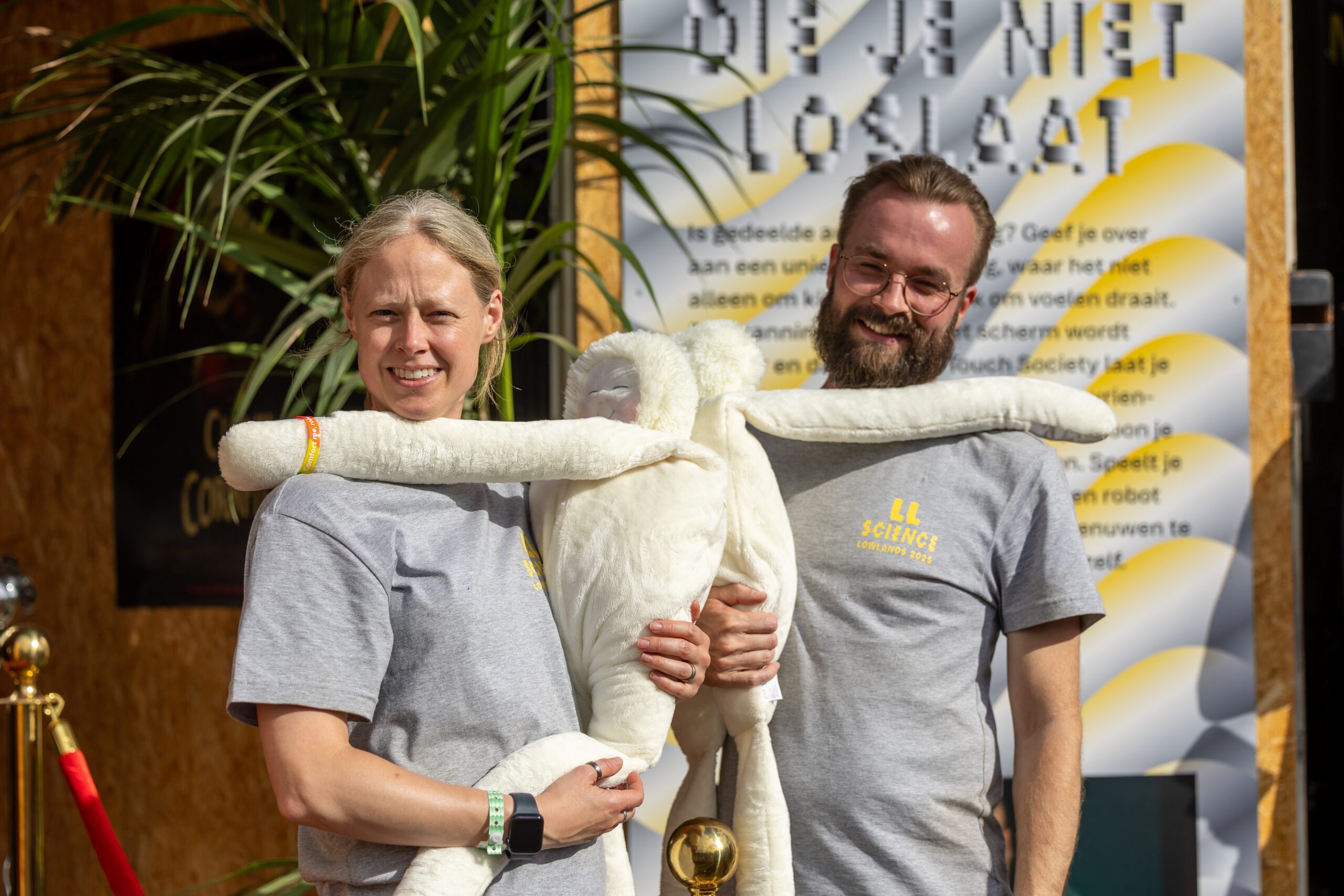
One of the participants, Michael (24), tested the cuddle robot. The soft, white cuddle robot has long arms which you can put across your shoulders. If you hold it close, you can feel a heartbeat. It makes Michael feel comfortable. “At home I always sit under a blanket.” His friend Shoshannah (26) held hands with a complete stranger. “It felt a bit strange, but at the same time not that strange. It helped keep me calm.”
In a few containers further down is Annelot Broerze, a doctoral candidate (Civil Engineering and Geosciences, CEG). She wants to find out what Lowlands visitors think of her climate intervention research.
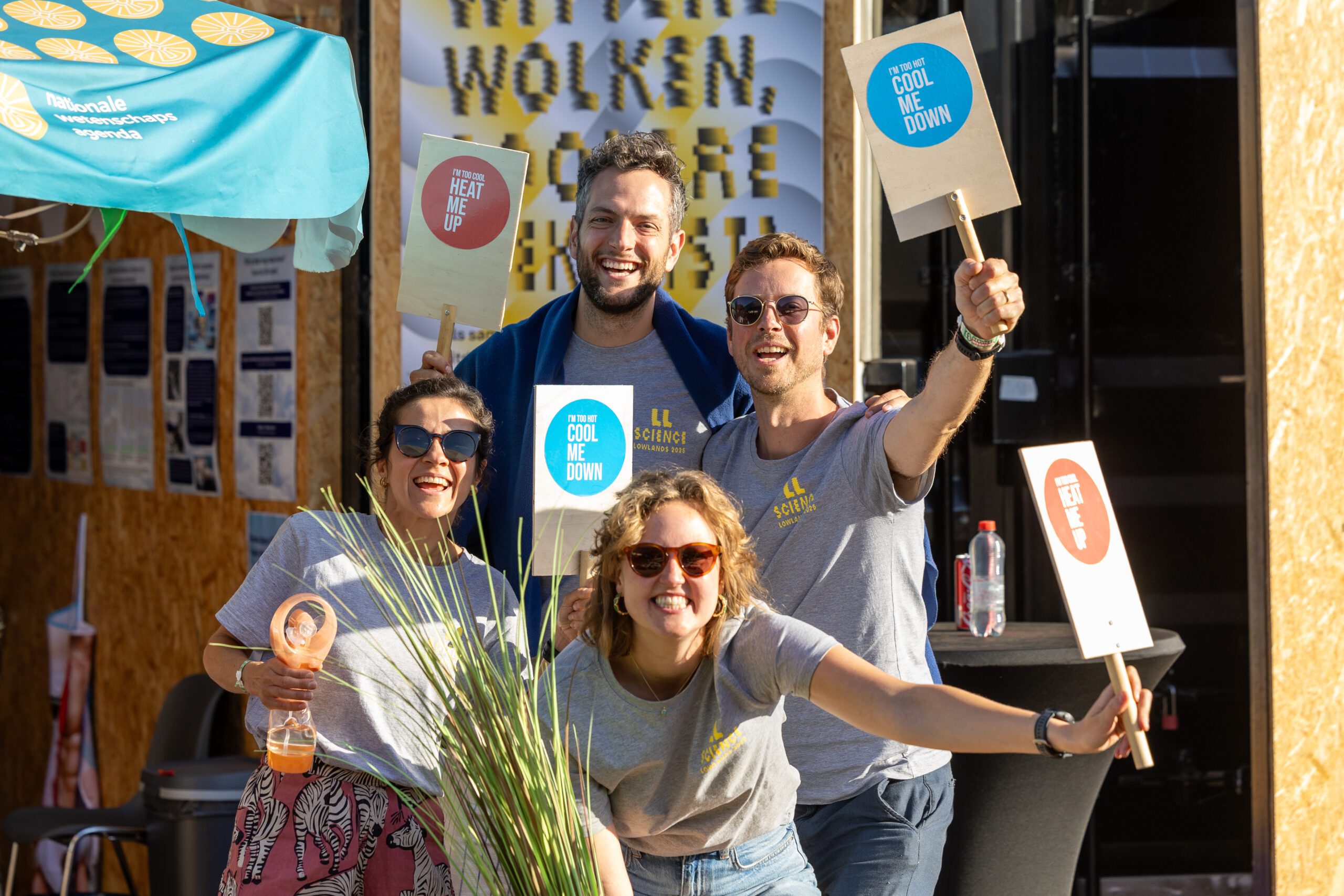
Broerze is researching marine cloud brightening. This involves spraying seawater in the air. The salt then makes the clouds more compact and, as it were, the clouds become whiter. This reflects more sunlight, which cools the earth. Research estimates that if this technology would be used at a large scale in the future, it could theoretically cool the earth by three degrees.
Support
But is this desirable, messing around with clouds? What would the consequences be? Or is it important to deploy all the options to reduce global warming, even if you would rather not use them? Broerze wants to know what visitors think.
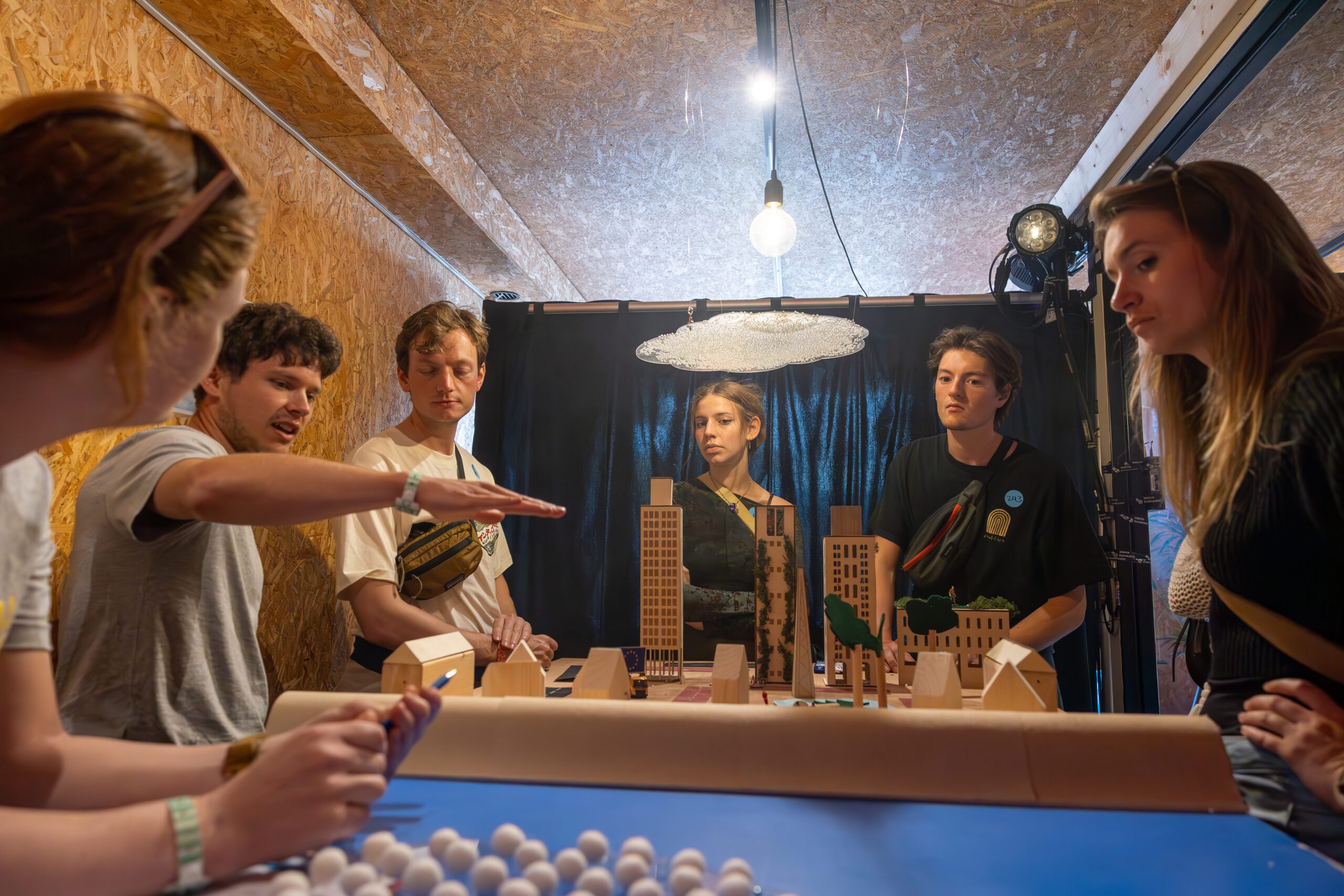
The most important part of her research is a questionnaire. As this is not a particularly appealing and fun exercise to attract festival goers, Broerze has added some entertainment. Her participants start on the dance floor where they dance to It’s Raining Men as ‘earths’, warming up and cooling down each other with chillies, mini-fans and warm blankets.
After that, Broerze or a colleague explain things to the participants who, better informed, then fill in a questionnaire and stick a sticker somewhere on a scale ranging from yes to no in answer to the question of to what extent they support Broerze’s research.
Recycled wastewater
Sander Wingelaar, also a doctoral candidate at TU Delft’s CEG Faculty, is standing at the other side of the Science field. Together with games developer Games XL, he designed a water pipe game that shows what water sources participants think are suitable for watering the garden, flushing the toilet, or drinking.
Wingelaar is especially interested in knowing what the visitors think of using recycled wastewater, which he says is not that common in the Netherlands. “But it is needed. And definitely now that the summers are becoming drier and water is becoming scarcer.”
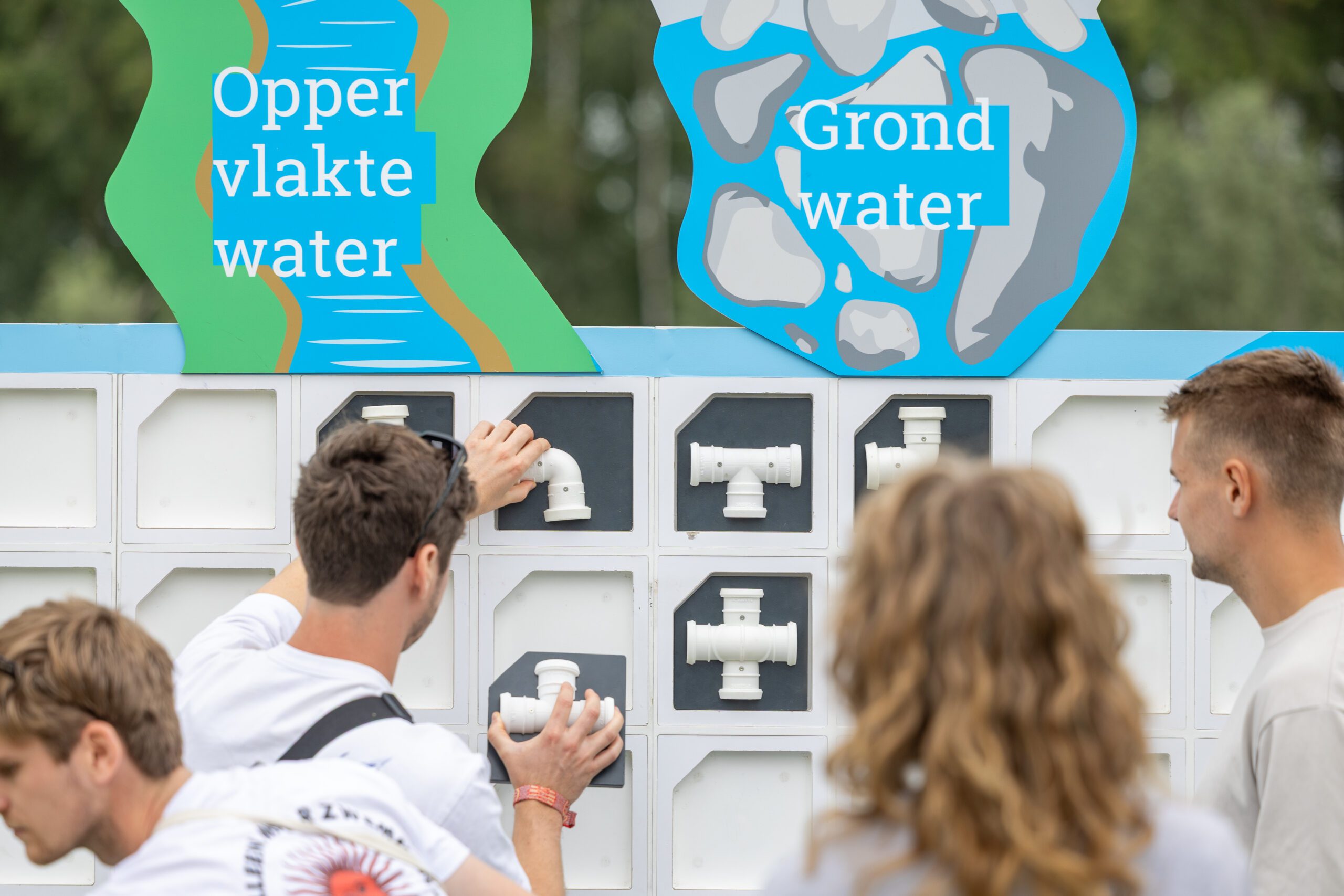
But while purified wastewater is just as clean as surface water or groundwater, many people still react with ‘yuck’ to wastewater. At least, that seems to be the current thinking, says Wingelaar. He is using his pipe game and the follow-up conversations to check how far this is the case for the Lowlands audience.
Tiring Saturday afternoon
Stefan (27), who recently graduated in political sciences at Leiden University, had never thought about wastewater. But he says that “if I can help science on a tiring Saturday afternoon, I will do so. But it was a late night yesterday,” he laughs. “I’m not sure how usable my answers are. I would have given better answers two days ago.”
Tuinman says that he will include a disclaimer in his publications. The relatively young, highly educated and often inebriated festival goers are not representative of the whole population.
That said, he believes that doing research at Lowlands has its advantages. For example, there is a constant stream of participants. “The good thing about this set-up is that you generate a lot of data in just a short time.”
Broerze believes that the importance of Lowlands Science goes beyond just collecting data. It is also communicating about science. “I think it is important to make people aware of the research that we do.”
Translating the science
This makes her very happy. “It is really nice to see how we scientists can translate our work to the general public. I don’t want to spend my days just doing simulations in my room.”
The Science corner is close to Alpha, the stage where the big artists perform. Does this mean that taking part in the research is especially nice to kill the time between the performances? Not for Mariëlle (38), who left her friends watching a band that she did not enjoy.
For her, the activities on the side are the main attraction. “My friends and I have different tastes. So I do my thing. More cabaret and science for example.” Broerze’s research got her thinking and this is exactly what she was looking for. “It is very special to be part of research. It is interesting to learn new things.”
Solo side quest
Lena (26), recently graduated, took part in Wingelaar’s water research. She saw that there was a Science corner in the Lowlands app. She was so interested that she specially went on what she calls a solo side quest. Its location next to Alpha was an added benefit. “I will go there right after to see Vampire Weekend.”
Do you have a question or comment about this article?
k.bakker@tudelft.nl


Comments are closed.