

Over the past fifteen years, more scientists came to the Netherlands than left, reports the Rathenau Institute. There appears to be no brain drain.
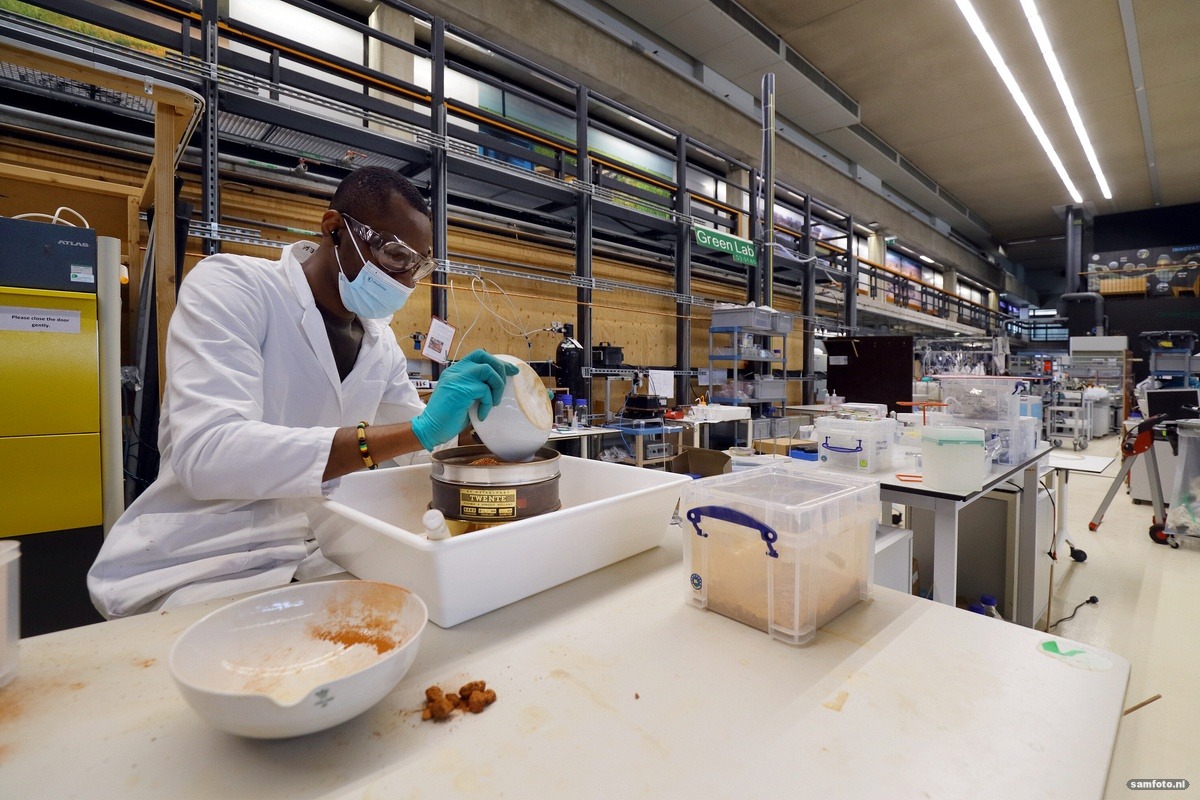
The CEG water lab. (Photo: Sam Rentmeester)
The departure of top Dutch scientists sometimes sparks heated debate. We’re driving them away, critics say. And also: do the best foreign researchers still want to come here?
Such debates arise, for example, when universities want to place less emphasis on publishing in prestigious journals in their HR policies, and instead offer more room for teaching, leadership, collaboration with industry and science communication.
‘Recognition and rewards’
This policy is known as ‘recognition and rewards’, and some critics fear that the Netherlands may lose its focus on scientific quality and risk falling out of step with international standards. Similar concerns are voiced about open science: why should you mainly publish in journals that are freely accessible to everyone, if those behind a paywall are better for your scientific reputation?
But there seems to be little cause for concern, writes the Rathenau Institute in a new report (in Dutch). Science is a revolving door, says the Hague-based research institute. In terms of both numbers and quality, the influx and outflow of researchers appears to be fairly balanced. At least, between 2008 and 2023. That’s before the government introduced its budget cuts.
Slightly more scientists came to Dutch universities and research institutes than left
This is based on data from the Web of Science database. It shows how many articles scientists publish and which institutions they are affiliated with at the time. This allows you to track where authors move. You can also see how often their articles are cited by others.
First, the numbers. Slightly more scientists came to Dutch universities and research institutes than left: 17 percent versus 14 percent. And that’s comparable to other countries.
Those who come to the Netherlands sometimes leave again: 29 percent do so within a few years. The reverse also happens: a quarter of scientists who leave the Netherlands return within a few years.
Technical sciences attracted many researchers
During the fifteen-year period studied, the share of foreign researchers at Dutch universities grew from 40 to 48 percent. Technical sciences in particular attracted many researchers: in that field, 40 percent more researchers came here than left.
The quality of migrating researchers also matters. It would be unfortunate if all the good scientists went abroad and the Netherlands received fewer high-quality international researchers in return. That wouldn’t be a good trade.
Little difference in citation scores
But that’s not the case, according to this research. To assess the quality of scientists, the Rathenau Institute looks at their ‘citation score’: a widely used measure of the impact of scientific articles. The idea is: the more often peers cite your article, the more influential your research is.
Those who come and go don’t differ much in this regard. At least, generally speaking. Per discipline, the picture varies slightly. Dutch agricultural scientists have a high citation impact overall. Those who come tend to score lower than those who leave, almost by default.
In technical sciences, looking only at 2023, better-scoring researchers seem to be coming here. In earlier years, that pattern is less visible. Incidentally, the Rathenau Institute does not conduct these analyses for the social sciences and humanities, as they are underrepresented in the Web of Science data.
Baseline and speculation
The institute calls this a baseline measurement. International mobility of scientists may change due to ‘increasing geopolitical unrest’, speculate the report’s authors. ‘Recognition and rewards’ (the HR policy in which scientific excellence is no longer the sole criterion) may also have an effect.
But compared to Germany, France, the United Kingdom, Sweden and Switzerland, the Netherlands is currently performing averagely. France attracted the fewest researchers, tiny Switzerland the most. Relatively few scientists left Sweden, while more left the United Kingdom.
HOP, Bas Belleman

HOP
Hoger Onderwijs Persbureau
Do you have a question or comment about this article?
redactie@hogeronderwijspersbureau.nl


Comments are closed.