Politicians want to reform the funding of higher education, but how? The Royal Netherlands Academy of Arts and Sciences (KNAW) has already identified the shortcomings of the current system.
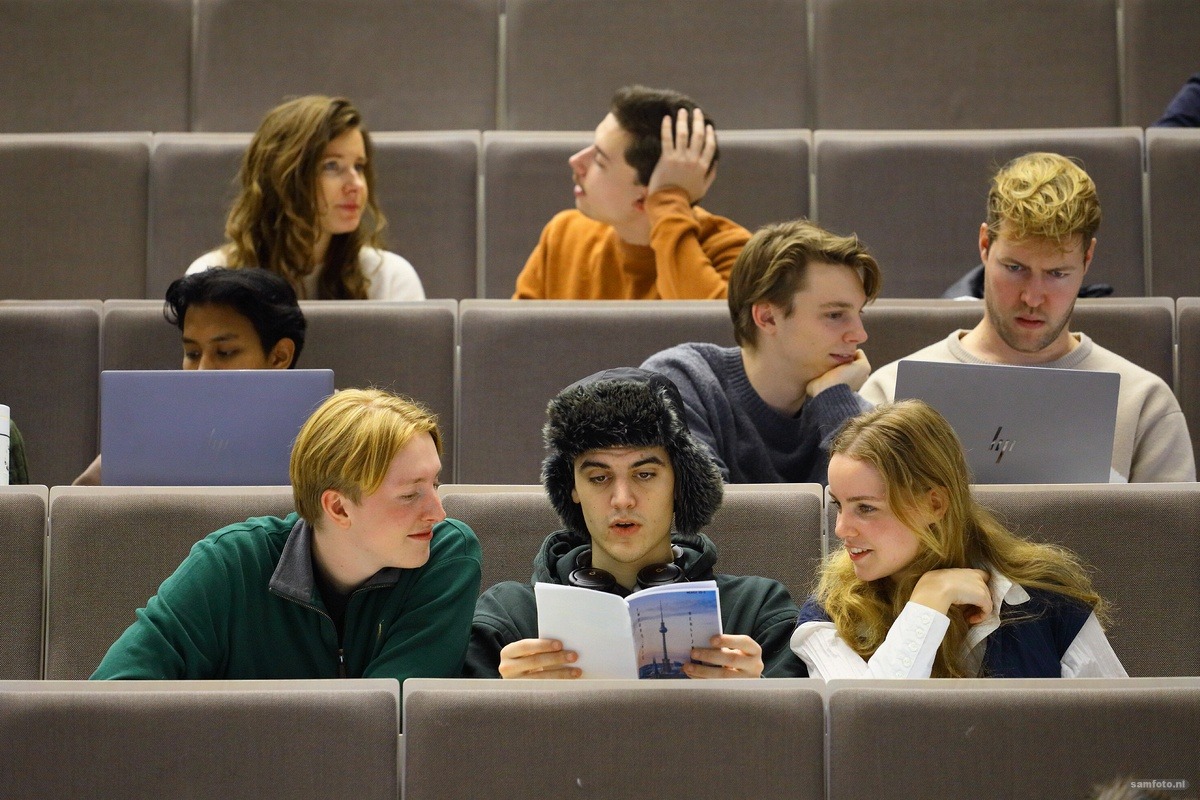
When allocating the billions in education funding, the Ministry takes into account, among other things, the number of students. (Photo: Sam Rentmeester)
Every year, the Ministry of Education allocates billions of euros to universities and universities of applied sciences. Among other factors, it takes the number of students into account. More students means more money. That’s great when you’re growing, but what do you do when numbers are falling? Higher education has been grappling with this question for a few years now, as student numbers are declining. After years of rapid growth, can higher education cope with a period of decline?
In The Hague, some parties are alarmed by the initial consequences. Institutions are laying off staff, scrapping small degree programmes and dismantling research groups. And the decline has only just begun. Is this down to the funding system? What are the ins and outs of it? And will politicians resolve the issues?
The Royal Netherlands Academy of Arts and Sciences (KNAW) has analysed the bottlenecks in funding, ahead of a report due later this year. It appears that changing the system will be no easy task.
1. Historical arbitrariness
At times, the system is baffling. Universities, for example, receive a so-called ‘fixed allocation’. A portion of the nationally available budget is distributed among the institutions according to fixed percentages. TU Delft receives 14%, Wageningen 7.9% and Maastricht 4.8%. The KNAW has been unable to ascertain where these percentages originate.
It seems unlikely that the system will be tinkered with
Similar fixed allocation percentages are also laid down in law for universities of applied sciences. As there are twice as many universities of applied sciences, the percentages are lower, but here too they vary considerably: Fontys receives almost 9%, the universities of applied sciences in Rotterdam and Groningen 6%, and Avans 5%.
Will politicians change this? The KNAW has not yet issued any advice, but it seems unlikely that the system will be tinkered with. This distribution of the ‘fixed percentage’ goes back a long way, to before the 1980s. You could shake up those percentages, but that would lead to a lot of internal friction, and that is probably something nobody wants.
2. More students, same amount of research funding
Education and scientific research are intertwined, say the KNAW and the universities: you want students to be taught by researchers. If there are more students, the research budget must also increase, is their reasoning
Politicians presumably do not want to get their fingers burnt here
That is not happening: whilst the number of students and degrees awarded has grown significantly in recent years, the research budget for universities has not kept pace. The education budget, however, has increased accordingly.
Will politicians change this? That would require a substantial injection of extra research funding, so it seems unlikely. Moreover, the number of students would then determine how much research is carried out, and that fails (in Dutch) to recognise the value of research that is independent of teaching. Politicians presumably do not want to get their fingers burnt here.
3. International students
Notably absent from the KNAW analysis are the budgetary implications of the growing cohort of international students. They have generated significant revenue for universities over the past decades and, due to their sheer numbers, have now become a major factor.
In 2010, there were around 24,000 foreign students studying in Dutch higher education. By 2024, this figure had risen to 93,000. This represents over a quarter of the university student population. This has advantages for the institutions.
European students are funded by the government, just like Dutch students. They graduate more quickly, which is good for the finances. Non-European students pay a high ‘institutional fee’, so the institutions do not lose out on this either.
The truth is that the presence or absence of international students is likely to have a far greater impact on higher education than any change to the funding system
Will politics change this? The previous government wanted to curb the influx of international students, particularly in undergraduate programmes. The new government is breaking with that policy, but it remains to be seen how things will pan out in the future. The cold hard truth is that the presence or absence of international students is likely to have a far greater impact on higher education than any change to the funding system.
4. The role of administrators
The authors of the KNAW analysis write that the funding system has ‘adverse consequences’ for programmes with many students taking longer than the standard duration or those studying for two degrees simultaneously. After all, they receive no funding for these students. Small programmes would also struggle under the current system.
There is a buffer between the government and the degree programmes: the Executive Board
But there are nuances to this. However convoluted the system may be, the institutions ultimately receive a single large sum in their accounts, which they are free to allocate among their degree programmes. There is therefore a buffer between the government and the degree programmes: the Executive Board of the university of applied sciences or university.
Administrators can say: this major programme is receiving so much funding that we can use it to keep a few small but important programmes afloat. Or they might say: we are going to close this small programme, even if politicians think that’s a shame.
Will this change? Politicians have shown that, for example, a chair in Frisian can easily be arranged: there is now a separate budget for that. But do you have to fight for this in the House of Representatives for every single small programme? Nobody has time for that. It is quite possible that the new government will set up a ‘small programmes’ committee to decide on this at national level.
5. The aim was growth
The KNAW raises the question of exactly what purpose the funding system serves. Once upon a time, the aim was to attract far more people to higher education, both from within the Netherlands and from abroad. In that case, a system that stimulates growth makes perfect sense.
How many theoretically educated graduates do we actually need?
Is this objective set to change? In politics, growth is no longer the only thing that counts. ‘Higher’ is not always better, is the new mantra. During his time as D66 Minister of Education, former KNAW President Robbert Dijkgraaf launched the ‘fan’ concept: vocational education (mbo), higher professional education (hbo) and university education (wo) do not form a ladder, but a fan. One is not superior to the other. We also need many skilled workers from vocational education in the Netherlands.
It seems only a matter of time before this ‘fan’ concept has consequences for the funding of higher education. It is quite possible that politicians will want to exert greater control over this: how many theoretically trained graduates do we actually need? Perhaps, in exchange for more stable funding, there will be a maximum number of students for all sorts of study programmes, as is the case with courses such as medicine.
6. Accessibility and selection
Paying for a specific ‘capacity’ of students? Universities are keen on the idea of so-called ‘capacity-based funding’, even though the details have not yet been worked out.
We must await the final advice, but the KNAW sounds less enthusiastic for the time being. In the Netherlands, anyone with a havo or vwo diploma can go on to study at a university of applied sciences or a research university. If you introduce a cap, you will have to resort to mass selection. In the United Kingdom, this is the norm, and every year a proportion of young people are unable to secure a place. A previous working group has already described this as undesirable, the KNAW notes (in Dutch).
Will access change? In politics, there are strong advocates of selection in higher education, whilst others warn of inequality of opportunity. This will undoubtedly play a role: who will be allowed to study and who will not? And how much funding will be available? A great deal of water will flow under the bridge before a decision is made on this.
7. Workload
Workload is a problem at universities and universities of applied sciences. Early-career researchers in particular often hop from one temporary contract to another and have to fight for research grants. But even experienced researchers spend a great deal of time writing research proposals, most of which are rejected.
Science is a kind of pyramid: there are few places at the top
Will politicians change this? The Netherlands Organisation for Scientific Research (NWO) allocates the majority of grants. Politicians are unlikely to do much about this: it is a way of channelling funds to the ‘best’ researchers or the most ‘relevant’ topics. In fact, politicians repeatedly come up with a science agenda, key area, top sector or growth fund to which money is temporarily channelled.
Moreover, science is a kind of pyramid: there are few places at the top, so many researchers have to put their best foot forward to reach that summit. This, too, is unlikely to change under a new system.
8. Autonomy
Who holds the power? The crux of the matter is not just how much money should be allocated to higher education and research, but also who decides how it is distributed. At present, in principle, that is the institutional board.
Will politics change this? You always see the government meddling with the autonomy of higher education, for better or for worse. The government is constantly trying to dictate something, for example that students must study faster (penalty for taking too long to graduate) or that collaboration is important (sector plans).
Stable funding sounds good, but what is the trade-off? Will the government increasingly dictate what institutions must do? That is a real possibility.
HOP, Olmo Linthorst
- Read more about the cuts to higher education and at TU Delft in our dossier.
HOP
Hoger Onderwijs Persbureau
Do you have a question or comment about this article?
redactie@hogeronderwijspersbureau.nl


Comments are closed.