

It was a busy night on campus on the night of 7 to 8 April. Whilst tram 19 was making its very first test run, researcher Marco Langbroek was operating the new MISO research telescope on the roof of his Faculty of Aerospace Engineering to film the Artemis II spacecraft.
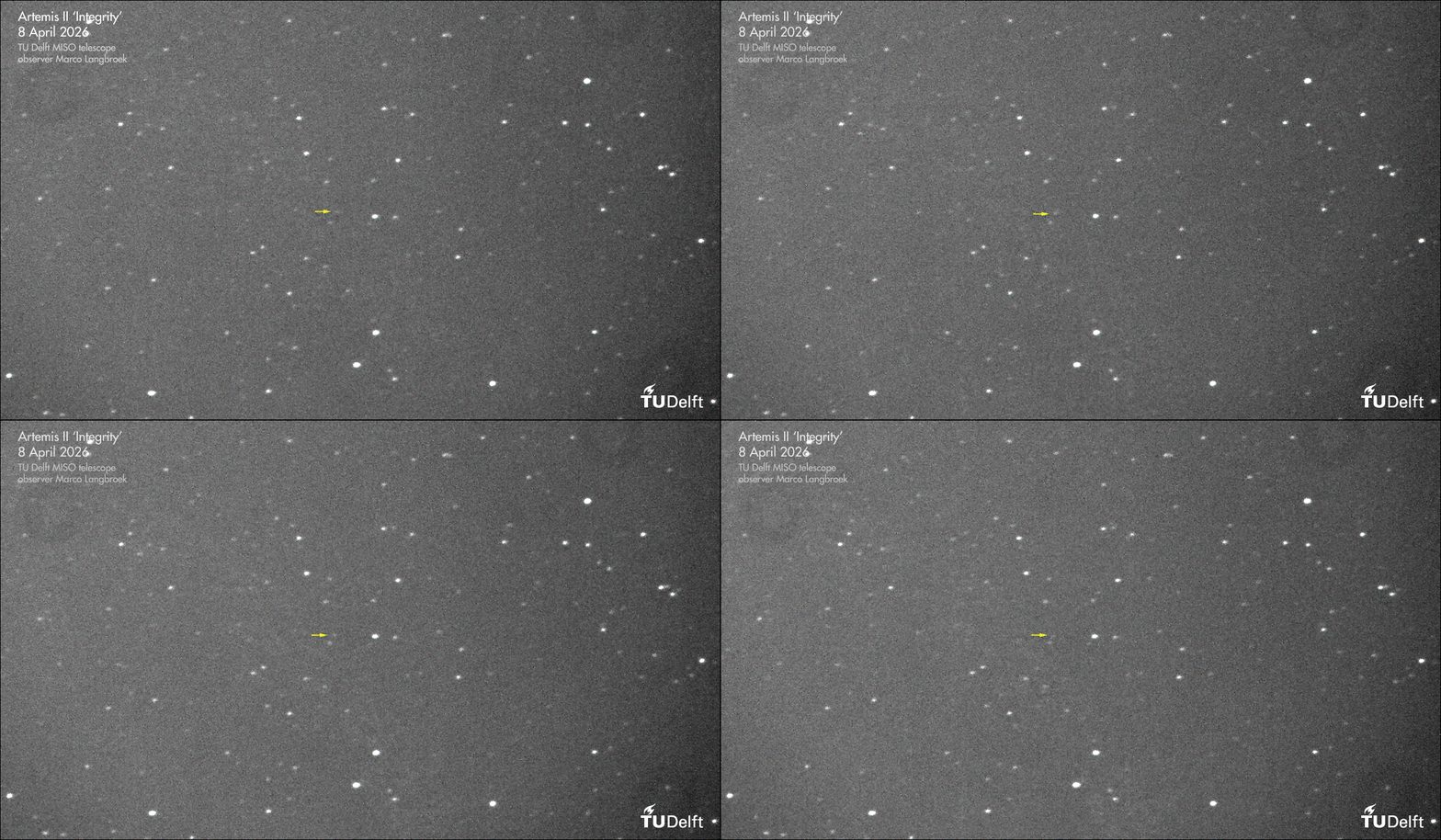
Artemis II as seen from the roof of AE. (Image: Marco Langbroek)
Satellite orbit expert Marco Langbroek still can’t quite believe it the following morning: he has managed to film Artemis II. The manned spacecraft was launched on 1 April, flew past the Moon just over five days later, took some impressive photos there, and is now on its way back to Earth.
Langbroek took four ten-second shots during the night of 7 to 8 April, captured within a span of one and a half minutes. “I hadn’t thought that Artemis would actually be visible under these conditions,” he explains over the phone. “The spacecraft was 359,000 kilometres away. That’s almost as far as the Moon. What’s more, it was only 8.7 degrees above the horizon: less than the width of your hand when you look at it with your arm outstretched.”
Research telescope for laser communication
Nevertheless, he managed to make a short video. Thanks to the new MISO (multiple-input single-output) research telescope on the roof of the Faculty of Aerospace Engineering (AE). The telescope is part of the Satellite Communication and Orbital Mechanics Laboratory (SCOMlab) and is led by project manager Rudolf Saathof. The instrument is primarily intended for experimenting with laser communication with satellites.
‘I am glad I gave it a go’
But Langbroek’s night-time experiment on campus is a good example of what else is possible with the research telescope. “It is a versatile instrument that we can also use for space situational awareness,” says Langbroek. SSA involves mapping, tracking and analysing objects in space, both man-made (such as satellites) and natural (such as comets). With the increasing traffic in space, SSA is a growing field.
Artemis II is due to return to Earth during the night of 10 to 11 April. Will Langbroek try to film it again before then? “I might give it another go tonight, although the conditions will be even less favourable. Artemis will be closer to the horizon then, and it’s already starting to get a bit lighter in the morning. But I managed it tonight too. I’m pleasantly surprised by the result and I am glad I gave it a go.”
Science editor
Edda Heinsman
Do you have a question or comment about this article?
E.Heinsman@tudelft.nl


Comments are closed.