Two TU Delft alumni, Charly de Wit and Lennart van Gameren, will open the Dineum, a pop-up museum for edible art in The Hague. Here you experience the works of art by eating them up during a full evening tour. Why are they doing this and what influences has TU Delft had on their plans?

Alumni Lennart van Gameren and Charly de Wit are opening their own pop-up museum. (Photo: Dineum)
This article in 1 minute
Eight floor cushions lie in a circle on the floor in a round tent. Between them are round wooden serving dishes. Everything looks normal. Up to now. But then the tent starts to move in time to the sound of breathing. It is a very strange, but funnily enough, also a calming experience. The tent expands on inhalation and folds in on exhalation. It is as though you are in the very depths of a lung. The breath tent is the last space of the art route through the pop-up museum voor immersieve eetbare kunst Dineum (Dineum pop-up museum for immersive edible art) as it is called in full. It opens on 30 April.
Before reaching this point, visitors have already followed an art route through six spaces, each with their own story. One is a surrealistic cave-like space with garlands of purple light that abstractly represent the start of food. Here your food grows on your plate while you are eating. This effect is created using a technology called reverse spherification that is used in the De Librije Michelin star restaurant in Zwolle. In another room you put your head and arms through holes to enter a sort of diorama. In this piece of art, every mouthful that the visitor takes has been thought through beforehand and was made one fork at a time.
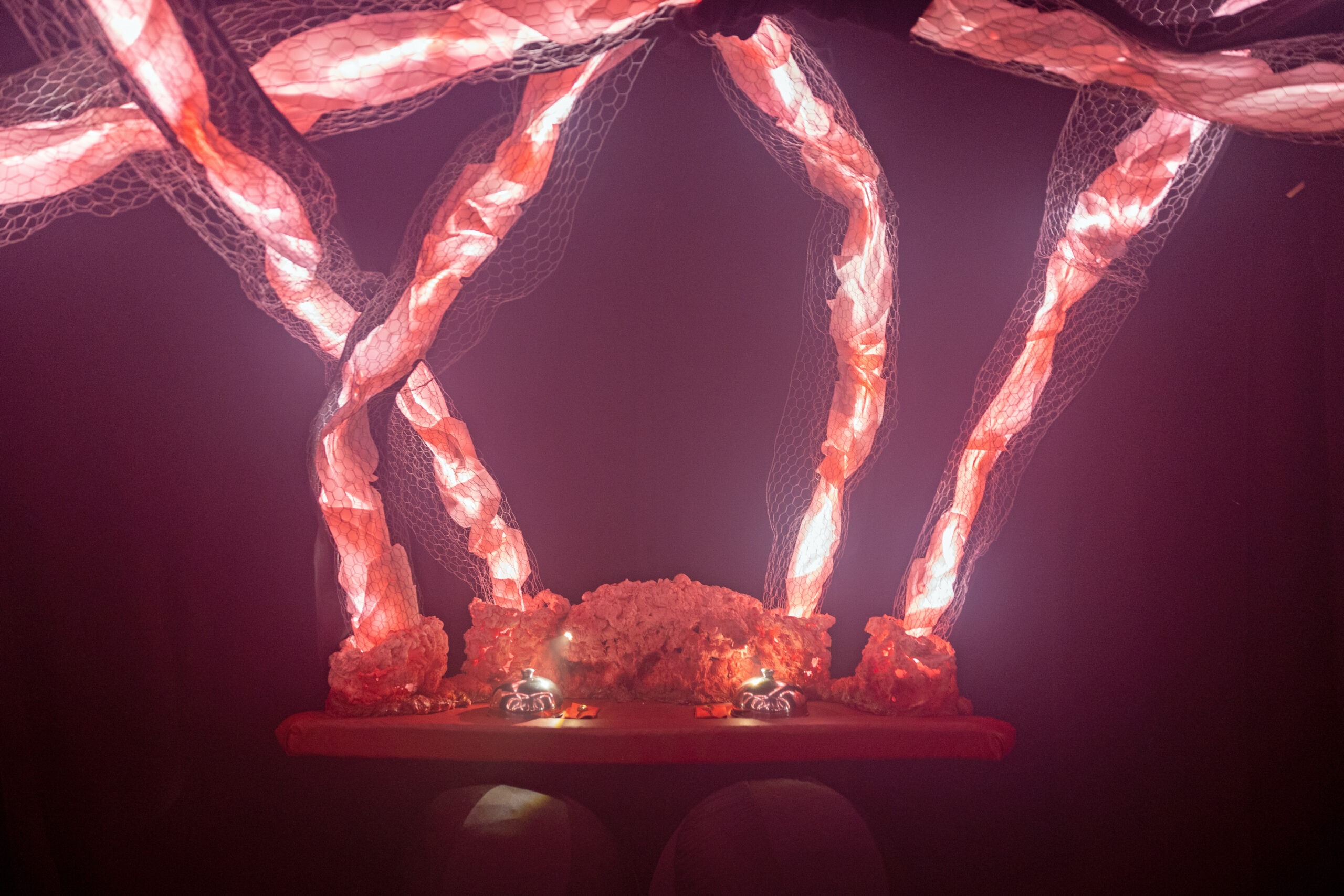
Every bite is made fork by fork
“The art consists of the consumption experience that then gets you thinking,” explains Charly de Wit (31), the creative mind behind the installations and, together with her business partner Lennart van Gameren, the initiator. Every piece of art is an installation which you can enter with up to eight people. A performance artist brings the edible pieces to the visitors to bring the ‘story’ of each piece of art to life. The theme of the experience is ‘The life of food’ and it delves into all the phases that our food goes through. “The rooms are about the origins, production, consumption and the end of food. Each has a striking perspective that makes you think, sometimes uncomfortably or feeling strange,” explains Charly.
A lot of TU Delft technology
What a lot of people do not expect is that there is a lot of technology – including TU Delft technology – logistics, and entrepreneurship involved. How would you otherwise ensure that 64 forks holding a warm bite can be served efficiently every half hour without an oven. And that thereafter everything is cleaned and made ready for the next group. Behind the scenes Dineum is full of small and big technical crafts that visitors hardly notice as they are caught up in the experience.
“We can’t show the whole art collection now as it is only complete if you eat,” says Charly during the tour. She studied Mechanical Engineering and then did a master’s in Industrial Design Engineering. After graduating she worked for a year as a strategy consultant but found that it did not really make her happy. “I had already done a couple of projects on food, such as in 2019 when I was involved in the ‘What do we eat’ exhibition in the TU Delft Library. In the exhibition I showed how consumers were misled by packaging. I then asked the question if we should use that same deception to make people eat more responsibly without them realising it. Food is about much more than just food. The idea eventually rose about art which revolves around the eating experience itself.”
‘Food is about much more than just food’
During the pandemic she built a few installations for the Maassilo in Rotterdam called ‘Food Art Experience’. That then stopped because of the second lockdown. She got a job at TU Delft where she worked as a researcher at IDE for 10 months. “It was a project about storytelling design to make children at primary schools aware about a healthy lifestyle and healthy food. Really nice.” In the interim she continued working on art in an unheated anti-squat basement that she could rent in Rijswijk. After her period as a researcher, she worked at a small company for a few years that designed rides and activities for the funfair industry. When she had to stop working there in the autumn of 2025 because of the aftereffects of the pandemic, this was the start of working full-time on art to show the world. After a long search she found a suitable location on the Elandstraat in The Hague which she could use temporarily for one year. The building will then be demolished and replaced by housing.
Study Advisor at TU Delft
Her business partner Lennart (32) has known Charly since they were both members of the Sint Jansbrug student association. He studied Architecture and the Built Environment and then did a master’s in Industrial Ecology at Technology, Policy and Management (TPM). After graduating in 2020, he was an advisor in climate adaptation and went into environmental management. He was also a Study Advisor at the Science Centre where he introduced children to technology and helped at the TU Delft Science Centre behind the scenes.
Lennart has always been involved in Charly’s projects, but last autumn he felt that the time was right to be a part of them. “To turn the museum into reality we have to do things like recruit and manage personnel, be visible on social media, and apply for permits from the municipality. This is all related to my work as an environmental manager. And like Charly, I also enjoy thinking about the customer journey, which I also did when I was working at the Science Centre. It is pretty intense and all our free time and weekends are spent on it.”
‘The creative elements are not something you learn at TU Delft’
They both agree that TU Delft gave them the know-how to work out this project technically. All sorts of things they learnt in their studies are reflected here: mathematics, technology, logistics, can-do mentality, and solution-oriented work. “Only the creative elements are not something you really learn at TU Delft. You need to have it in you,” says Charly.
The Dineum will only be open on Fridays and Saturdays at first. A new group of eight people will do the art route every half hour and there will be eight rounds every evening. One round takes three hours. “If we sell a lot of tickets we may get a sandwich at the end,” says Charly. “For us it is about passion as this has never been done before.” The price is reasonable, she believes, although the Dineum is not targeted at students. “We will also give people with a museum pass a discount. If you expect a restaurant, you are in the wrong place. It is really about the art and the underlying message. But to understand the message, you need to eat part of the art.”
- More info on Dineum.nl (in Dutch)
Do you have a question or comment about this article?
[email protected]


Comments are closed.