

Have you ever wondered whether bacteria produce sound? Researchers from the Faculty of Mechanical Engineering have built tiny graphene trampolines to listen to bacteria. What do these organisms sound like? And what’s the point?
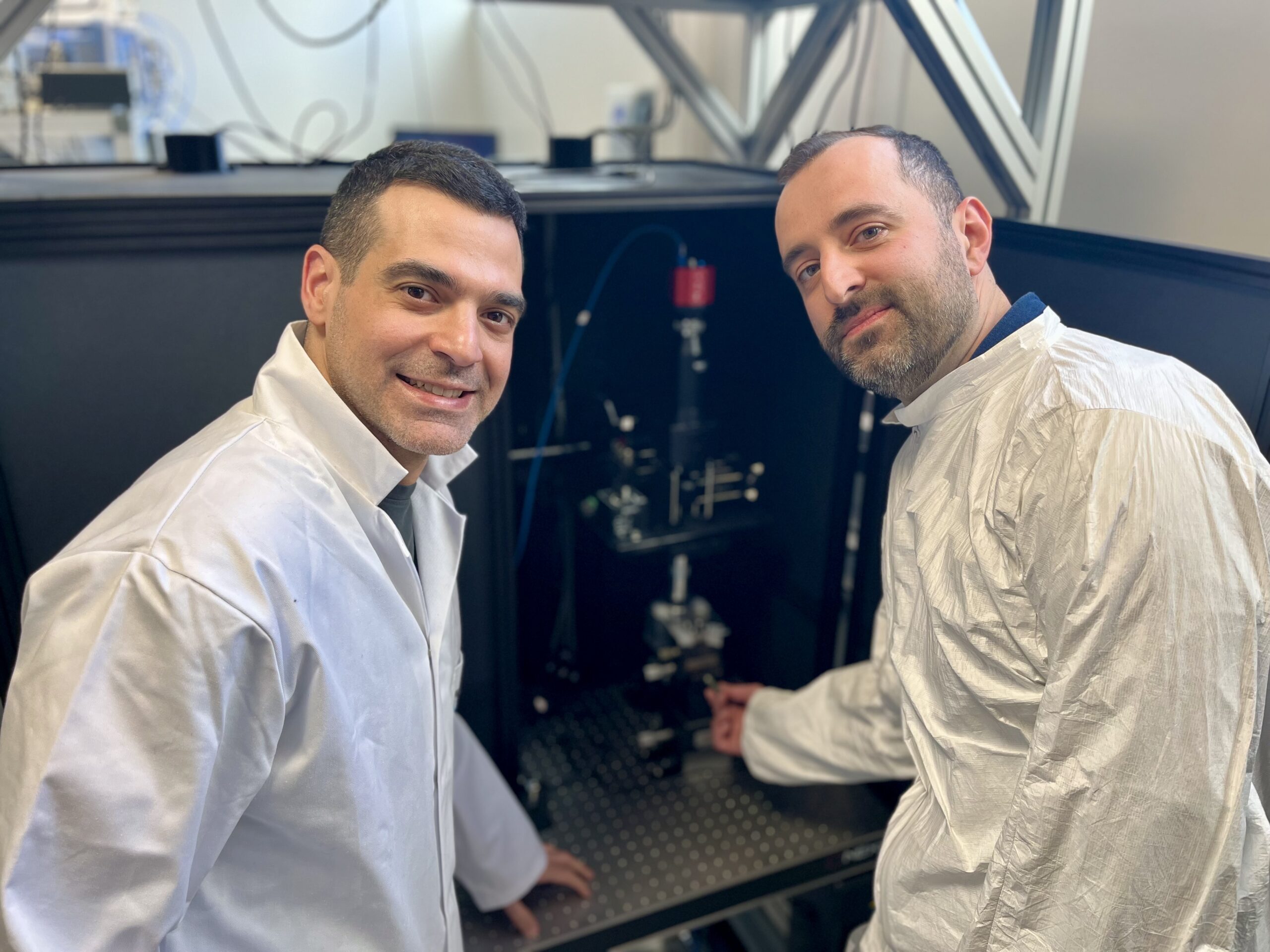
Farbod Alijani and Aleksandre Japaridze (Mechanical Engineering) with an experimental prototype of the device they use to listen to bacteria. (Photo: Delta/Edda Heinsman)
It all began with the new wonder material graphene, which Farbod Alijani was busy experimenting with in the labs of Precision and Micro Systems Engineering, within the Faculty of Mechanical Engineering. Graphene is extremely thin, just a single atomic layer thick, hence it is referred to as a two-dimensional material. It has remarkable properties: it conducts both heat and electricity very well along the plane, but hardly at all in the perpendicular direction. It is extremely strong, yet flexible and transparent. “There is still a great deal we don’t understand about this material, so that’s what we were working on,” says Alijani.
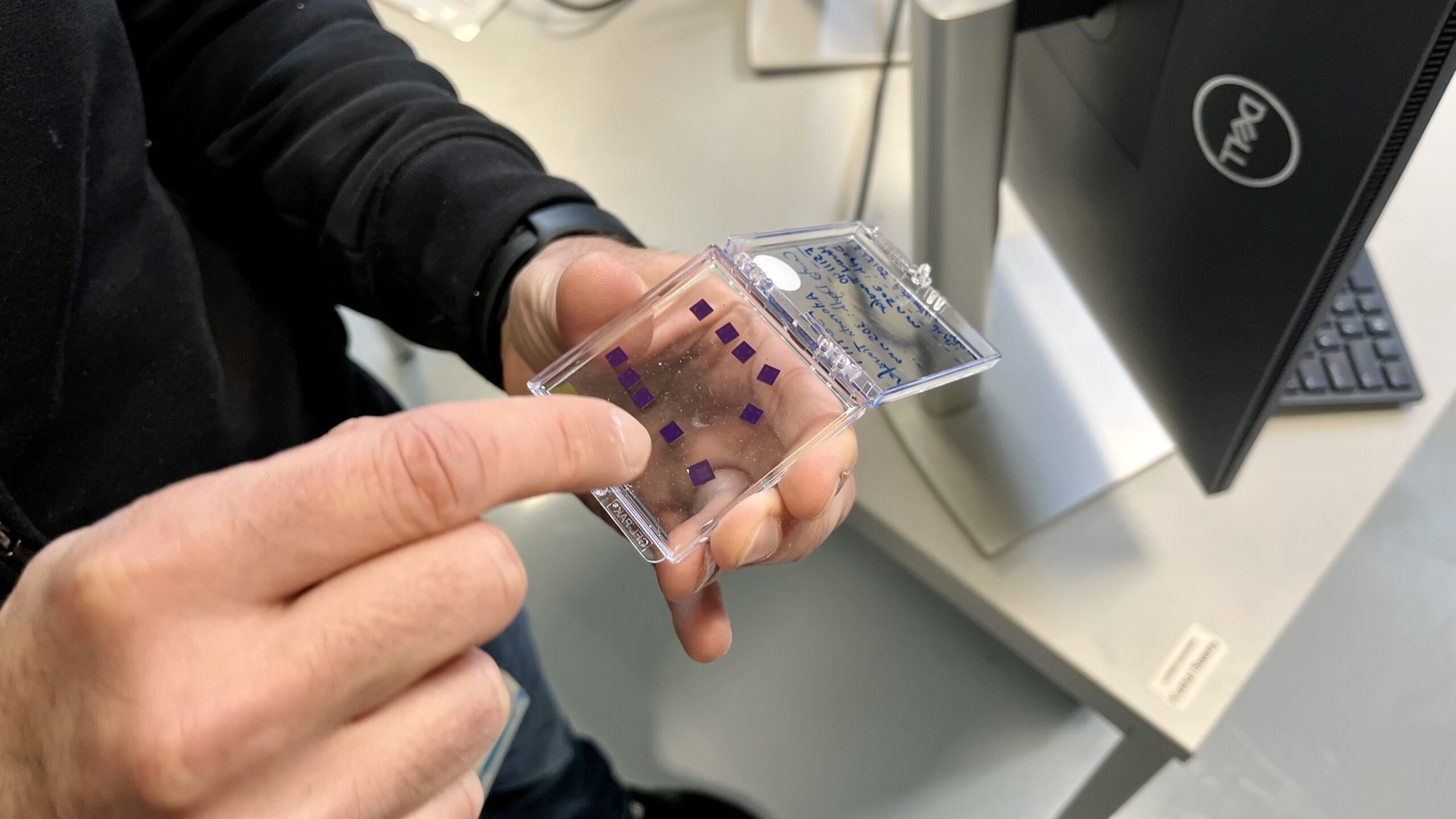
During a conference, Alijani heard about measuring bacterial colonies by placing them on tiny cantilevers. These cantilevers vibrate and those vibrations can be measured. Alijani realised: we have graphene, so we can do this better.
Together with Aleksandre Japaridze and Irek Roslon, he set to work trying to detect the vibrations of individual bacteria. And it worked! Right from their very first ‘quick Friday afternoon experiment’. “We added bacteria to the drum, and we immediately saw that the motion changed. It was the signature that we were really measuring bacteria,” says Alijani. The enthusiastic scientists told everyone about their success. The lab was promptly closed. They didn’t have permission to work with bacteria. Alijani recounts the story with a sense of humour.
After those successful initial measurements, the researchers quickly realised what the next step had to be: adding antibiotics, seeing how the bacteria reacted to them, and whether they could measure it. And indeed: when antibiotics were added, the bacteria’s movements stopped, and with them the vibrations.
🎧 Living bacteria:
🎧 Dead bacteria (with antibiotics):
The researchers founded the start-up SoundCell. They expanded their team, improved their prototype, and conducted tests in collaboration with Reinier de Graaf Hospital. Meanwhile, they considered their next steps. “Do different bacteria speak different languages?” Is it possible to identify the species based on the vibration patterns of different bacterial types? They applied AI and machine learning to vast amounts of bacterial data and indeed found that each species has its own pattern. In this way, they hope to simultaneously identify the species and rapidly determine which antibiotics are effective against it.
“Normally, growing enough bacteria for testing takes a lot of valuable time,” says Japaridze. “With this new method, we can work much faster, and with a high degree of accuracy.”
It will be some time before the findings are actually put to use in hospitals. But the researchers believe the technology has clear market potential. They are now focusing on patients with sepsis, a severe inflammatory response in the body, that can damage tissues and organs. “A rapid diagnosis is therefore of enormous importance,” says Japaridze. “In the Netherlands alone, there are up to 55,000 cases per year.”
The research began with a playful experiment on a Friday afternoon. With the startup – a serious business – does the team still have time for such experiments? “I’m very much in favour of weird experiments,” says Alijani. “We are looking into how bacteria dance together, how they communicate with each other, how swarming happens. The story is still unfolding.”

Do you have a question or comment about this article?
E.Heinsman@tudelft.nl


Comments are closed.