

Humans will soon be heading back to the moon, but the launch of Artemis II, which was planned for this week, has been postponed until March due to technical problems. What makes this launch unique and why is launching so difficult? Five questions for Sebastien Welters from student rocket association DARE.
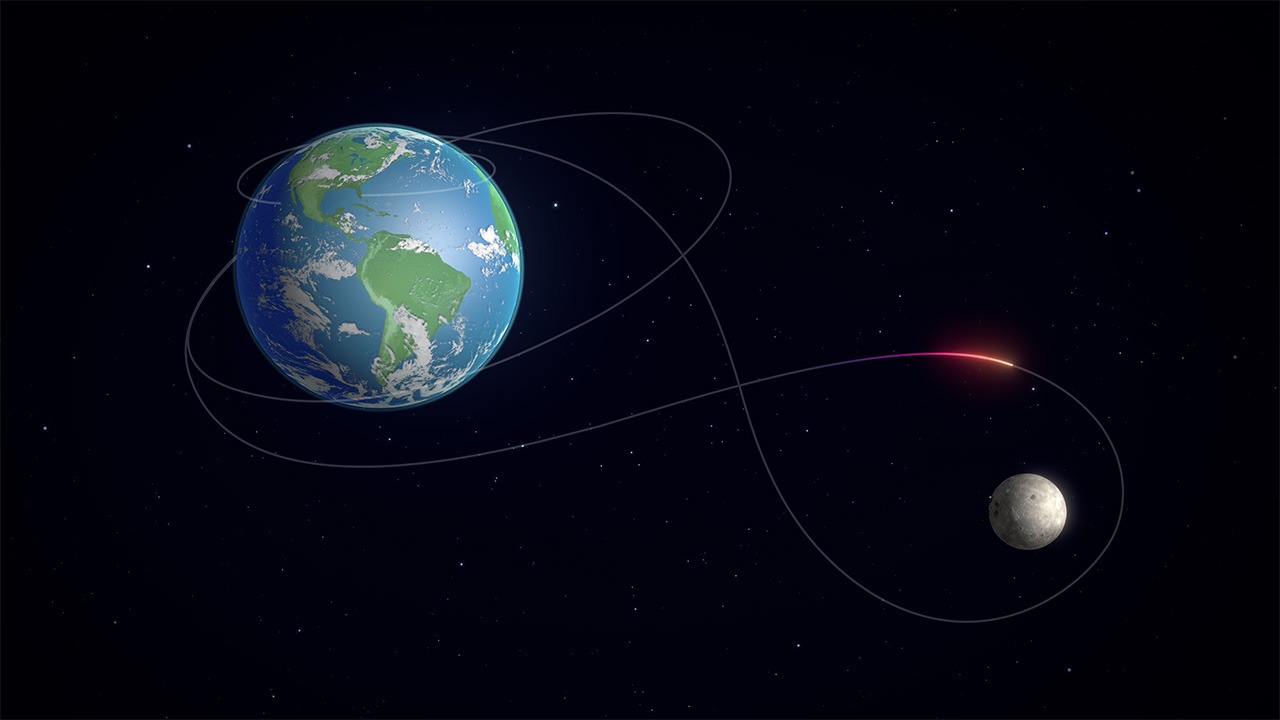
Artemis II trajectory. (Image: NASA/JSC/Goddard)
“Even when the launch is in the middle of the night, I’ll set my alarm and be ready with a bowl of popcorn.” Sebastien Welters, secretary of Delft Aerospace Rocket Engineering (DARE), has already followed many launches, but he thinks the upcoming Artemis mission is extra special. “It’s incredible that after more than fifty years, we’re sending four people to the moon again. It’s fantastic that humanity is heading in that direction! The mission is a collaboration between the United States, ESA and many other parties. And the fact that Airbus Netherlands is developing the solar panels, and that a lot is also being done in Europe, makes it even cooler.”
The final rehearsal for the rocket launch was postponed due to freezing conditions, which pushed back the entire schedule by several days. Now a leak has been detected in the hydrogen system, which is delaying things even further. Why are launches postponed so often?
“A rocket consists of so many parts that it is possible for a single small flap or valve or component to malfunction. And because it is such an important mission, with people on board the rocket, everything has to be perfect. They would rather take a few extra days to do it right than put four human lives at risk. And it’s not like a car. When a car stops working after two metres, you can repair it. Once a rocket launches, everything has to be perfect, because you can’t make repairs during take-off. Rockets are controlled explosions.”
The leak in the hydrogen system that is now causing problems for Artemis-II was also the reason why the DARE team was unable to launch the rocket at the last minute last autumn. What was the issue?
“One of the valves was frozen, causing fuel to leak. That’s why we had to decide not to launch, which was quite a difficult choice when you’ve been working on the rocket for two years. But the system was no longer completely safe. And for DARE, safety is paramount. We may get another chance this year.”
‘If you launch close to the equator, you get a free boost from Earth’
Does it matter where you launch?
“The Artemis launch is at Kennedy Space Centre in Florida, quite close to the equator. That does matter. You need a lot of energy to launch a rocket. If you launch close to the equator, you get a free boost from Earth, about 500 kilometres per hour. That’s also why ESA launches its satellites from French Guiana. Launch sites are also often close to the ocean, so that the rocket parts that are jettisoned can safely fall into the sea.”
How does the Artemis launch work?
“These days, all systems are being checked and the crew is being prepared to board the rocket. A few hours before launch, the astronauts will go to the rocket and enter the Orion capsule.
Two types of propulsion are needed for lift-off. You have two boosters, one on the left and one on the right. These are very large solid rocket motors, i.e. they use solid fuel. They provide about 75 per cent of the thrust.
And then you have the orange central part of the rocket, the core stage, which is the liquid part. Once the astronauts are in the capsule, the rocket is refuelled with liquid hydrogen and liquid oxygen. There are continuous checks. If everything is okay, the countdown begins. That is the most critical period, when everyone is really 100% focused.
And then it all goes up into the air in one go. At that point, there’s nothing left to do. They can’t suddenly abort the launch. The crew in their capsule can still escape during launch. But as soon as the two solid rocket boosters ignite, the rocket takes off.”
How long does it take after launch to reach the moon?
“After about two minutes, the boosters burn out and are jettisoned, followed by the core stage after eight minutes. The rocket then switches to the next stage, enters orbit around Earth and then heads for the correct trajectory towards the moon. The journey takes about four days. It will be a lunar fly-by: no landing on the moon, they will fly past at a distance of about 7,500 kilometres. So not very close to the surface, but further than humans have ever been in space. I’m looking forward to it!”

Science editor
Edda Heinsman
Do you have a question or comment about this article?
[email protected]


Comments are closed.