
The Delft promise of 3,500 new social housing student rooms by 2030 is unachievable. DUWO and other social housing corporations have been unable to build much in recent years and have little certainty about future projects. Moreover, new figures paint a distorted picture.
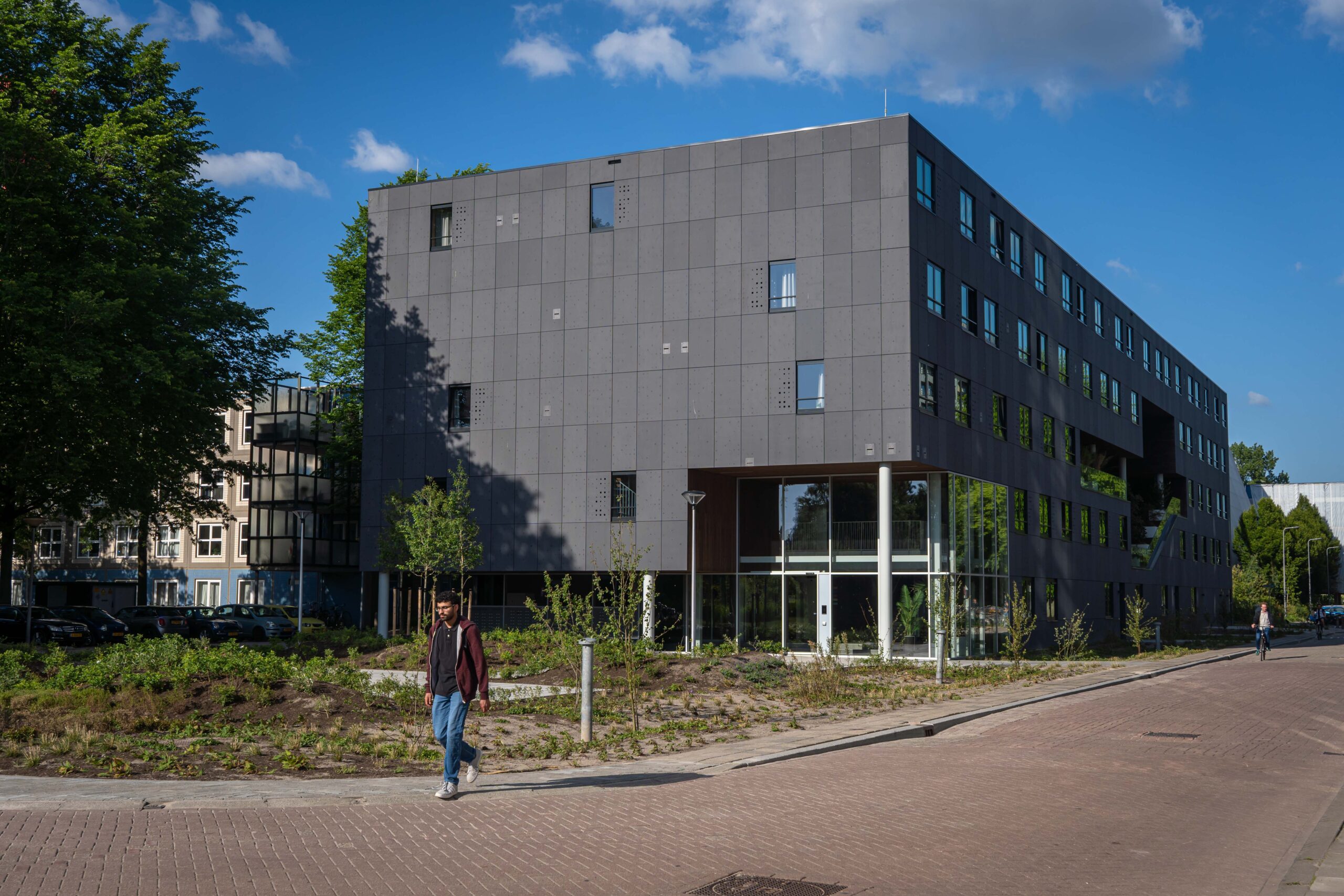
Balpol4 student complex, a few months after its official opening in March 2025. (Photo: Thijs van Reeuwijk)
That is evident from the Delft 2026-2031 Performance Agreements published this week by the municipality, housing associations and tenants’ organisations. These state that since 2020, “approximately three hundred” new student homes have been “realised”.
This figure appears to be distorted, especially when it comes to affordable new rooms. Enquiries with student housing provider DUWO, which checked with the municipality, reveal that it concerns only 279 units, of which merely 136 rooms are DUWO social housing: the Balpol4 complex on the TU campus, which opened in early 2025. The remaining 143 units are studios in the Pauwmolenflat, which opened in 2021. These studios belong to project developer B-Right, which is not a party to the performance agreements. Moreover, rents are at least partly above the rent limit of 932 euros for social housing. For example, in 2025, a student studio was offered for rent at 1,309 euros per month, excluding 195 euros in service costs.
The municipality’s new overview confirms what Delta concluded from its own research in November: the room shortage is worsening, because not only is private housing rapidly disappearing due to new tax rules, but new social housing is also not being built.
34 additional rooms in 2026
It is not that there are no potential projects for more social housing, but they will only yield 34 additional student rooms this year. The only other DUWO project that has “hard” status in the performance agreements and is therefore certain (457 student homes in the new Kabeldistrict) will not be ready until 2031 at the earliest.
The other DUWO plans have a “soft” status, meaning they are uncertain. :
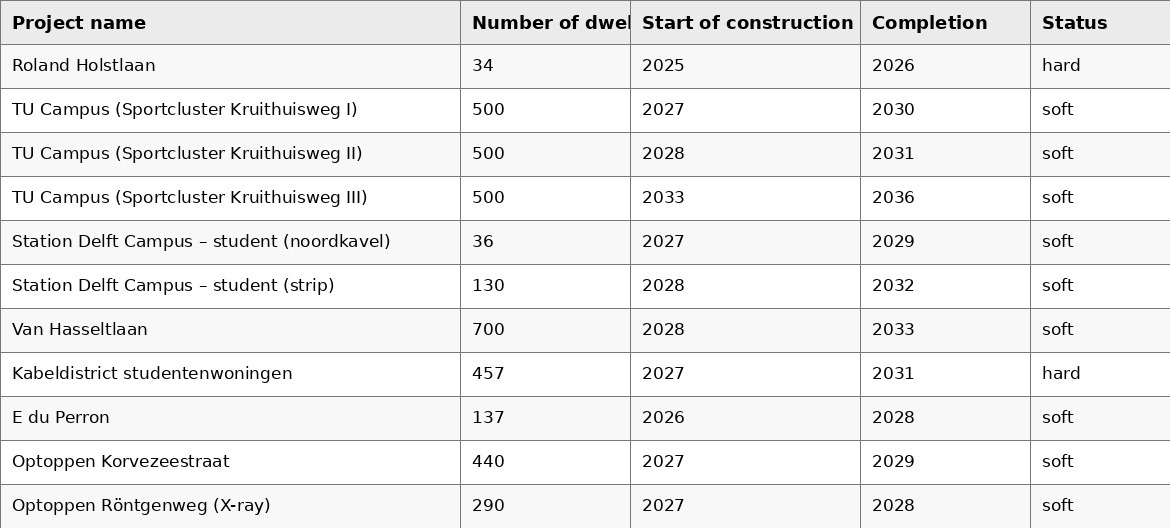
The performance agreements state that the realisation of the above projects will “in all likelihood” continue until after 2030. That is a very optimistic statement. The appendices show that by 2035, only 1,975 new social housing units will be added by DUWO, while 687 will disappear. It is not clear which ones these will be.
The new figures are a major setback for the current city administration. In their 2022 coalition agreement (in Dutch), STIP, D66, GroenLinks, PvdA and ChristenUnie agreed that they would raise the bar in terms of ambition: not 2,500 new social rental student homes in 2026, as had been promised earlier, but 3,500 in 2030.
Nevertheless, the partners say they will do everything they can to realise this ambition, for example by involving projects from housing providers other than DUWO, both in and outside Delft.
Non-self-contained rooms are difficult to build
Why has this not been possible in recent years? The performance agreements cite a variety of reasons. For example, planning is lengthy and complex, there are few suitable locations, there are planning and administrative obstacles, government policy is uncertain, projects are becoming increasingly expensive and there are too few people to carry them out.
An additional problem with student housing is that financing for shared student rooms is difficult to obtain. Current government policy on housing benefit is an obstacle, as are the property valuation system and rules on financing communal areas. This is unfortunate, because the municipality, student organisations and DUWO agree that communal living is necessary to combat social isolation.
It has therefore been decided that half of all new-build homes must be shared: traditional student houses with shared facilities or independent units around a communal area, known as the Sting concept. Balpol4 is an example of this.
Dependent on other parties
Another example could have been a complex of 660 temporary units on Heertjeslaan in Campus Zuid, announced in 2022, but that plan is not included in the performance agreements. Jelle van Kempen, the current branch director of DUWO, has never even heard of it. ‘We always have options for temporary situations, and these are often investigated, but unfortunately these plans fall through almost as quickly as they arise,’ he writes in an email.
Van Kempen points out that the ambition to build 3,500 homes is a municipal goal, ‘which DUWO naturally endorses, but cannot achieve on its own’. Van Kempen: ‘DUWO is making every effort to achieve this and we also assume that we will be the party responsible for building the majority of the homes. Of course, we are dependent on other parties for (primarily) locations.’
The municipality was not available for comment on Friday prior to the publication of this article.
- Read more about student housing in our dossier.

Do you have a question or comment about this article?
[email protected]


Comments are closed.