

Fears, lack of money or a physical condition… Tens of thousands of students feel hindered in their studies, reports the ECIO expertise centre. And not all of them raise the alarm with their educational institutions.

Photo for illustrative purposes only. (Photo: Thijs van Reeuwijk)
One in five students experiences obstacles to studying, according to the 2025 National Student Survey (NSE), which was completed by around 260,000 students. To be precise, it is 21 percent. At TU Delft, that percentage is slightly lower, at 19 percent. The Expertise Centre for Inclusive Education (ECIO) highlights this in a report (in Dutch).
Diverse
The problems vary greatly. As obstacles, these students often mention concentration problems, anxiety and stress, but also, for example, lack of money, transport or the physical accessibility of their schooling.
In the survey, students could also indicate what exactly the “special circumstances” in their lives were. Many of them said they have ADHD, dyslexia or dyscalculia. Autism and mental health issues are also mentioned relatively often. In addition, a significant group has to contend with “family circumstances”.
Joyful “obstacles” such as top-level sport or running their own businesses – which may also cause students to miss lectures and fall behind in their studies – are significantly less common according in this NSE survey.
Understanding
Most students feel that their institutions are understanding of their special circumstances. More than 60 per cent say so, while 11 per cent do not feel understood. The rest are neutral. Students at small and medium-sized educational institutions generally experience more understanding than those at large institutions.
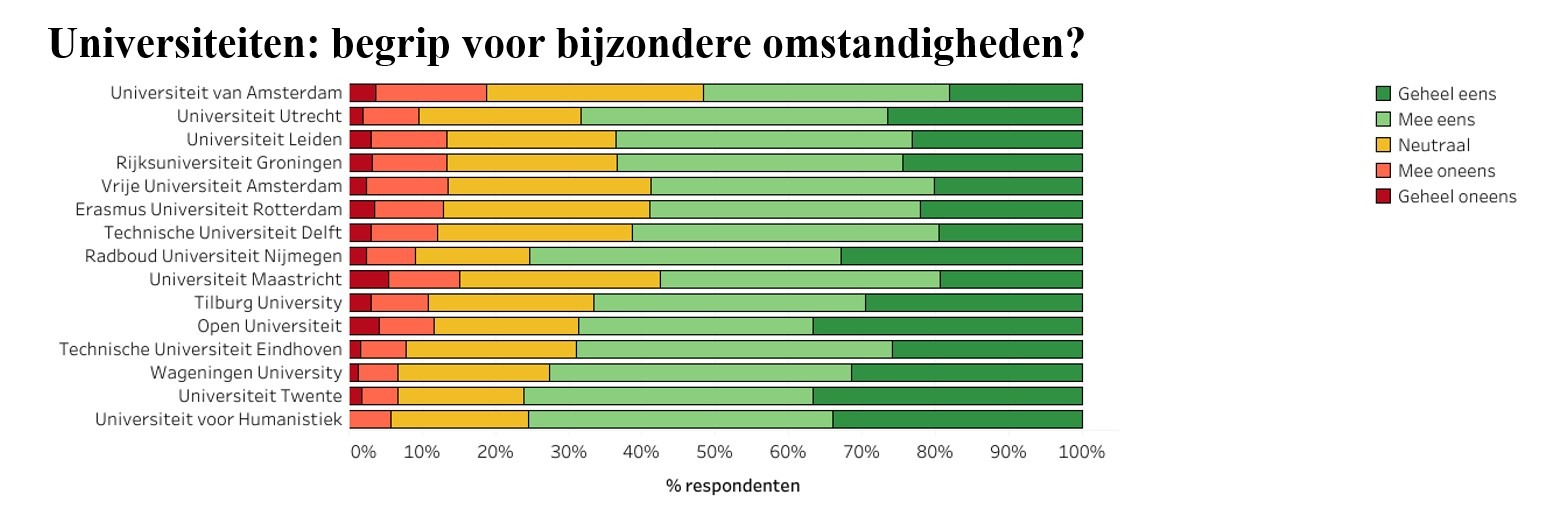
Are universities understanding of special circumstances? Dark green: totally agree, green: agree, yellow: neutral, red: disagree, dark red: totally disagree.
However, students do not always know where to go with their questions. For all topics covered by the ECIO (from compulsory attendance to financial concerns), a few per cent invariably find it “very unclear” who they should contact, and another 10 to 15 per cent say it is “unclear”. When it comes to concerns about money and housing, the percentage is even higher: around 25 per cent.
Satisfaction
65 per cent ultimately report the problems, with the percentages varying enormously between institutions: between 47 and 88 per cent at universities. Why don’t the rest do so? Half believe they do not need support despite the obstacles, but there are also students who have too little confidence in their educational institution in this area.
Students who do report problems often have a meeting at their institution. At TU Delft, this concerns 67 per cent. 66 per cent of them are (very) satisfied with how the problem was handled. 70 per cent also report that TU Delft has made provisions to help them. Of these, 75 per cent are satisfied with those provisions.
HOP, Bas Belleman

Do you have a question or comment about this article?
redactie@hogeronderwijspersbureau.nl


Comments are closed.