At the end of September the Executive Board announced that all faculties and university services are required to roll out their plans to reduce expenditures over the next few years. What do the faculties’ cutback plans entail?
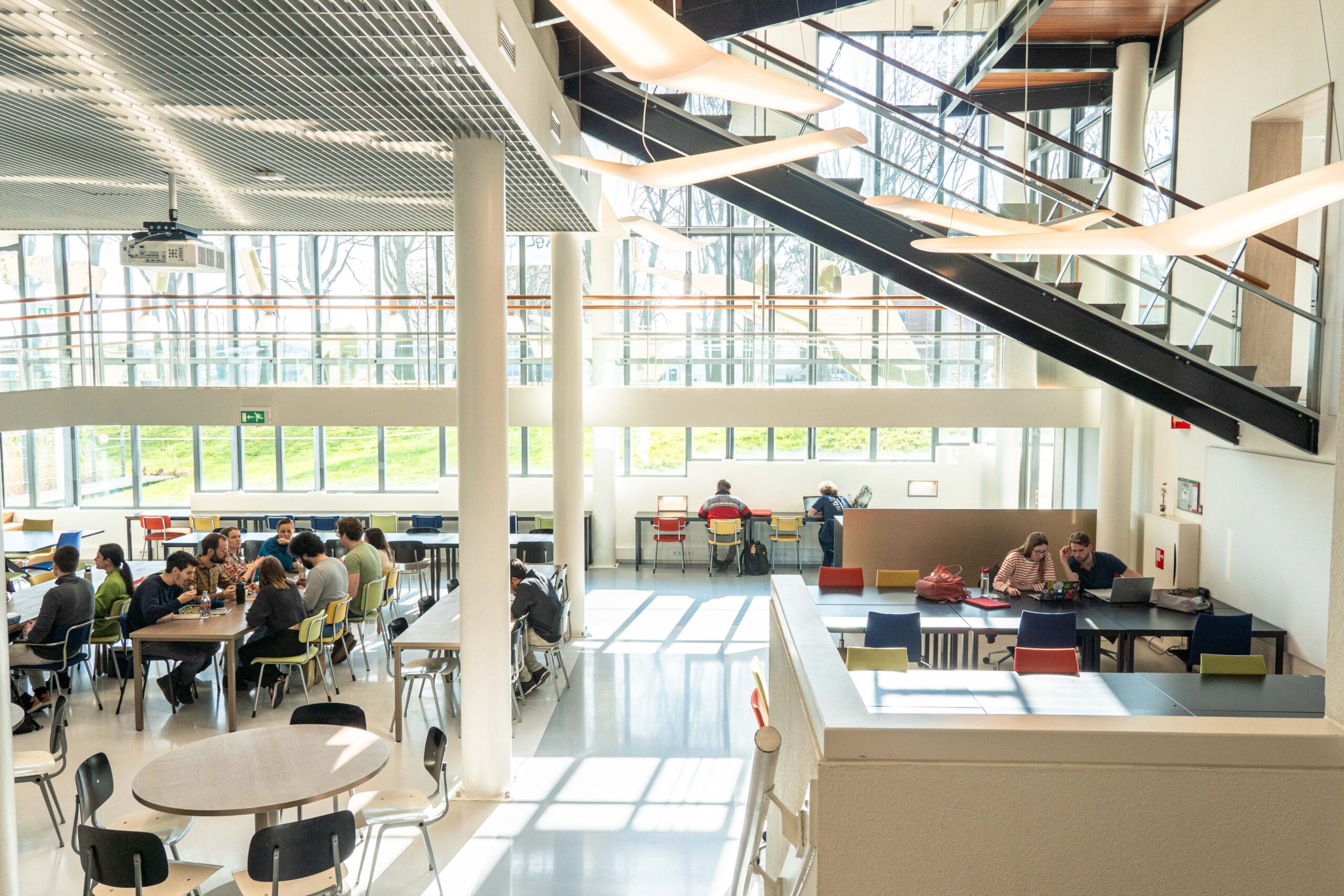
(Photo: Thijs van Reeuwijk)
On the day the Executive Board issued a notification about the upcoming cutbacks, five faculties shared their plans, or parts thereof, on the intranet. These were Architecture and the Built Environment (BK), Civil Engineering and Geosciences (CEG), Mechanical Engineering (ME), Technology, Policy and Management (TPM) and Applied Sciences (AS). These faculties intend to save money mostly through leaving vacancies open, reducing investments and maintenance, and by encouraging employees to take their leave entitlements.
Keeping essential knowledge
The remaining three faculties, Electrical Engineering, Mathematics and Computer Science (EEMCS), Industrial Design Engineering (IDE) and Aerospace Engineering (AE) are also introducing vacancy stops. Employees who leave will not automatically be replaced. The faculties do say that replacements can be sought if essential knowledge and skills may be lost.
At IDE the ‘natural turnover’ of staff could hit education too hard, states the Faculty in its plan. In particular, ‘some core themes will be hit too hard for both IDE and TU Delft’. But an economising strategy ‘that would only run in terms of substance, could lead to a reorganisation’ and thus not meet the Executive Board’s requirement of avoiding forced dismissals. This is why the Faculty chose to cut down relatively more on administrative and support staff rather than academic staff. To achieve this, the plan goes beyond only natural attrition to ‘(encouraged) voluntary attrition’.
Fewer student assistants
In their plans, EEMCS and AE state that the costs of hiring external employees also needs to be reduced. For both faculties this means that the number of student assistants will be reduced. AE posits that the number of student assistants rose sharply during the Covid pandemic period, and the Faculty wants to go back to the level before that increase. In its economising plan, EEMCS states that more and more student assistants were hired in the last few years to address the increasing workload, and the increase was ‘in line with the growth in student numbers’. Despite the stated risks of an increase in the ‘perceived workload’ and the further growth of the degree programmes, here too the number of student assistants must drop steeply.
In an attempt to avoid that the stop on filling vacancies creates or increases problems in terms of workload, the three faculties want to ensure that teaching takes less time. They want to make teaching less intense by taking action like scrapping electives, adjusting the teaching methods, or increasing ‘efficiency’ in other ways.
Alternative sources of funding
The three faculties also want to generate greater incomes. Despite the cutbacks, AE would like to invest in more research facilities and replace the research aircraft that it jointly owns with the Netherlands Aerospace Centre. To this end, the Faculty wants to ‘actively find alternative sources of financing’. EEMCS is planning to create better budgets for projects with external funding so that it does not face unforeseen expenses in projects later. IDE’s plan is to simply find a better division in terms of funding streams.
‘Most of the cutbacks do not have a major impact on education’
EEMCS is also looking for extra money within TU Delft. The Faculty states that it has submitted four files ‘where the Faculty will not manage without extra financial support from the Executive Board’. These are expanding the Computer Science degree programme; increasing the ‘Mathematics service teaching’ that the Faculty runs; the DelftBlue supercomputer; and, the clean room. The plan says that the Faculty expects a decision on these from the Executive Board later this year.
Impact on students
In most cases it is not clear what the impact of the cutbacks will be on students. In the meeting with the Executive Board on Wednesday morning, the Student Council asked the Board to require all faculties to produce an analysis of the impact on students. Board member Hans Hellendoorn said that this is highly complicated. “It is not a static system.” The faculties are introducing both cutbacks and new elements in their education simultaneously, which will make it hard to see the impact separately. The Student Council’s request to share the plans, which are accessible for staff members on the intranet, with students also got little resonance. “There are no plans to do this,” said Hellendoorn. “Most of the cutbacks do not have a major impact on education, so I do not know if it makes sense to email all students.”
- Read more about the cuts to higher education and within TU Delft in our dossier.



Comments are closed.